In the early 1980s, Konami was still trying to find its marks but exploring different ventures and expanding their business model in multiple directions. From the beginnings as a jukebox rental company, Konami tried to breach the arcade market, as coin-operated machines were becoming more popular. The first forays were mostly copies of already successful arcade titles, as the company tried to ride on the aura of Breakout (1976) and Space Invaders (1978)1.
Either way, while it is generally understood that Konami started to hit gold with the releases of Frogger (1981) and Scramble (1981), before their very successful pivot into the Family Computer in the mid-1980s. After that, we often find the same set of games, namely Gradius (1985), Castlevania (1986), Contra (1987) and Metal Gear (1987). But this last game should raise certain questions. After all, it was released on the MSX2 in June 1987, before being ported onto the Famicom in December of that year.
This gap in the early 1980s is really the result of our generally less precise knowledge of Japanese computer games, and warrants a little bit of historical context.
Without going too deep2, the Japanese computer market was split between a few key companies. The three groups that held most of the market were NEC with their PC series, Fujitsu with the FM series, and Hitachi with the MB series. Unfortunately, the architecture of the different microcomputers differed wildly, and it was hard to justify developing games for those platforms. Hence the idea of a standardised format. This was Kazuhiko Nishi capturing lightning in a bottle, and spearheading the MSX that was extremely popular in Japan when it released in 1983—a year before Nintendo opened the Famicom to third-party studios.
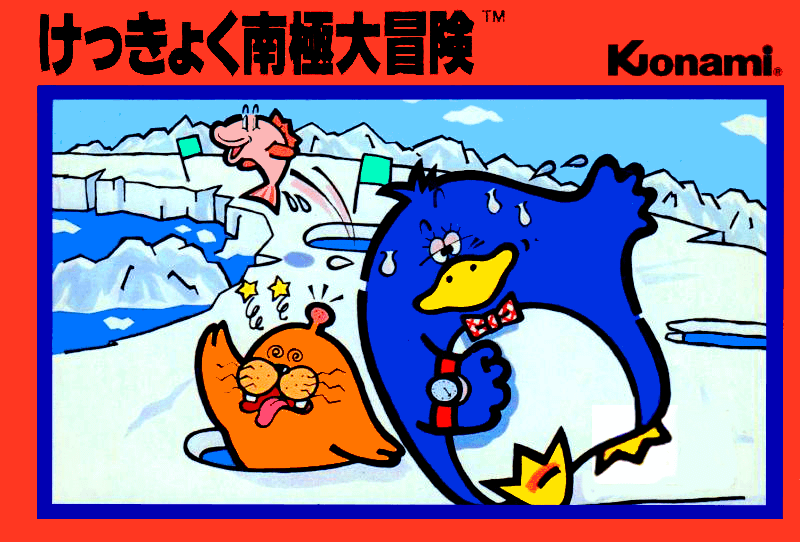
Kekkyoku nankyoku daibōken (1983), also known as Antarctic Adventure in the West, is part of Konami's push on the MSX and a good illustration of the company's strategy in the early and mid-1980s.
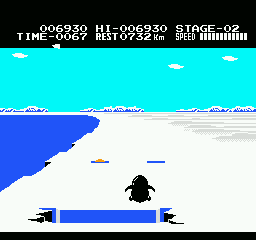
The goal of the game is pretty simple: rallying different research stations in Antarctica with our penguin, while avoiding crevasses and sea lions along the way. In fact, Antarctic Adventure is pretty much an imitation of Turbo (1981) by Sega, albeit at a milder pace. And for what it is worth, this is a nice experience. On every version, the 3D environment is quite believable and the controls pretty responsive, with this nice feeling of inertia in the turns.
Although quite repetitive on further loops, the game is well-balanced and boasts a few interesting strategies to run at top-speed during an entire segment. The Famicom version—the one I played—adds the propeller hat as a collectible item, that allows the penguin to float longer in the air, thus bypassing obstacles.
So why is nobody talking about this game?
Well, first of all, it is hardly accessible outside of Japan, even if most of the text is in English. And more importantly, it is a problem of chronology.
As mentioned previously, Antarctic Adventure is very similar to Turbo, the formative title for the racing genre. If this felt relatively fresh in 1983 when it was released on the MSX, it was probably not the case in 1985, when the genre already underwent several keys changes. Namco was again at the forefront of the innovation with Pole Position (1982) that opened the door for the more hectic racing games with rear perspective, especially with the addition of other racers and the position system.
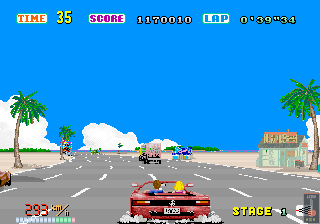
In that landscape, Antarctic Adventure feels a little bit lacking. The heuristics to avoid the obstacles are pretty simple, and the white landscape of Antarctica does not help to break the visual monotony of the titles. It really is not a bad experience, but it is easily superseded by other time-attack games that released before, and that is before even mentioning Nintendo's Mach Rider (1985) which released a few months after Antarctic Adventure. It really pushed forward the survival racer genre, paving the way for Sega's legendary OutRun (1986).
What remains of Antarctic Adventure?
More than a lasting influence on the video game landscape and the gameplay zeitgeist of the 1980s, it is perhaps more of a piece of history, something that showcased early decisions from Konami. This is a game of imitation, which does well what was asked of it. It spearheaded the company's efforts on the MSX, which stay strong until the 1990s. In a very computer-centric approach, Antarctic Adventure was also meant to be an educational game to teach a few flags to Japanese children, the first in an ambitious series.
At the same time, it was a nice cartridge to port on the Famicom, as third-party studios were adjusting to this new environment. With the rule of only five games per studios laid out by Nintendo, companies had to choose carefully what they wanted to promote. But in the early years of the console, easy ports were the way to go. Konami was not the only one doing late ports of their early titles on the Famicom, Taito's Space Invaders (1978) or Namco's Galaxian (1979) falling into the same problem.
But for the people who owned a Famicom, it was also a way to experience games at home, without having to visit an arcade or own a microcomputer. And there is always something so simple when judging games in retrospect, knowing what further evolutions there will be a few years after. But, in their publishing context, those games make sense. And they carry memories.
As a salaryman from Hiroshima explains, Antarctic Adventure evokes strong memories of the girl he liked as a child. He was poor and going to her place was entering, for a moment, another world. As mundane as Kekkyoku nankyoku daibōken can be, it is tied to possessing the Famicom, the same way the upper-middle class has a piano or air conditioning. And in this material context, complex feelings of love and class dichotomy intertwine3. That also is the legacy of this game, of all games.